
· by Michael Blair, Nashville's Roofers
Every roof replacement estimate worth having includes a line for decking, usually priced per sheet with a note that the final count depends on what is found. Homeowners read that as an open door. It is the opposite: it is the contractor telling you in advance that the one part of the roof they cannot inspect until tear-off may need work, and what each piece of it will cost if it does. Knowing what decking is and why it fails here makes that line on a roof replacement estimate easy to check.
What is under the shingles
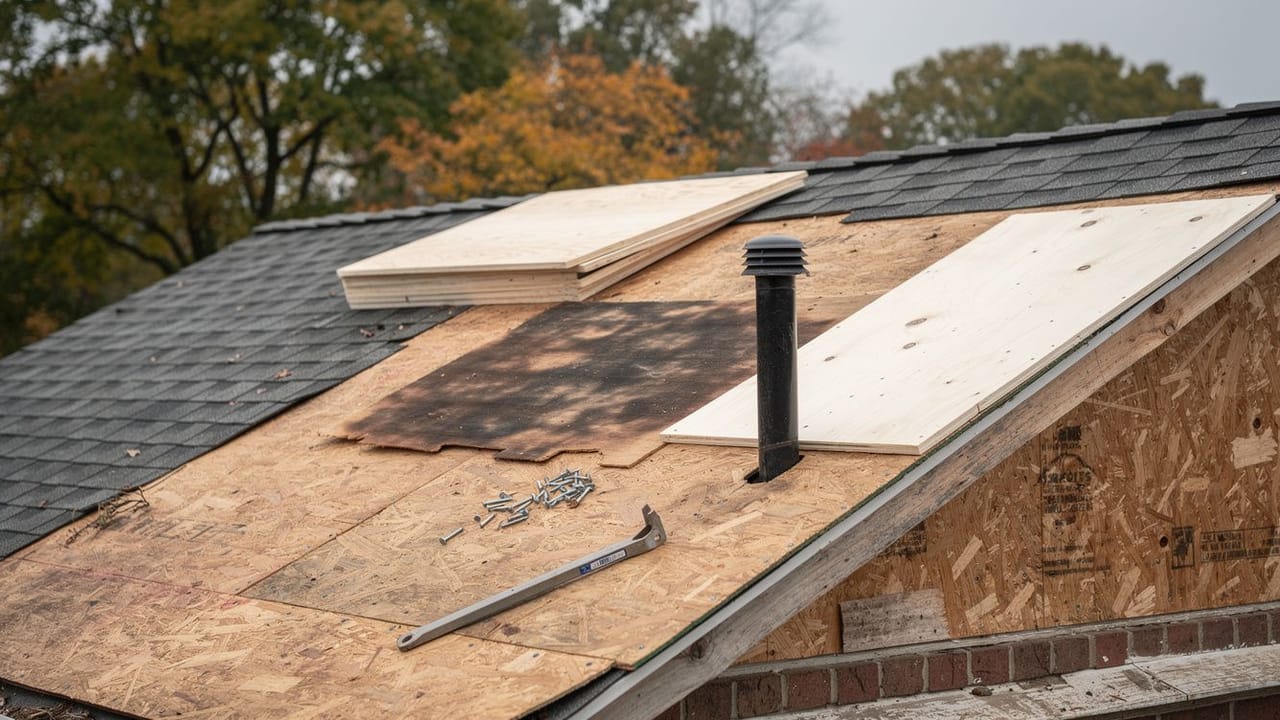
Decking, also called sheathing, is the layer the shingles are nailed to. Roof sheathing on wood-framed houses was once commonly made from boards and is now commonly plywood or oriented strandboard (OSB), according to the USDA Forest Products Laboratory’s Wood Handbook chapter on wood in buildings. On older Nashville houses we sometimes open up solid boards instead, occasionally with gaps between them, and on a few the spaced skip sheathing that was laid for wood shingles.
Shingles hold the water off; decking holds the shingles on. A nail driven into rotten or delaminated decking can loosen, and shingles held by loose nails are the ones we expect to lose in a straight-line wind. Wet wood is hard on the nails too: the same chapter says moisture content above 20% encourages corrosion of steel fasteners. That is why we will not nail a new roof over decking we know is bad.
Why does roof decking fail in Middle Tennessee?
Slow leaks are the obvious cause: a failed pipe boot or a valley that has been weeping for years keeps wetting the same patch of deck. Decay needs that kind of liquid water. The Wood Handbook’s chapter on biodeterioration puts serious decay above the fiber saturation point, about 30% moisture, and says the water vapor in humid air will not wet wood enough for significant decay on its own, though it will let some mold grow. So the attic matters through condensation rather than humidity alone, and the Forest Products Laboratory notes that metal fasteners are often the coldest surfaces, which draws condensation onto them. Our post on attic ventilation goes further into why that happens here.
Panels and boards fail differently. Plywood, unlike most panels made from particles, undergoes minimal irreversible thickness swelling when wetted, according to the Wood Handbook’s chapter on wood-based composites; OSB is built from strands, so after a long wetting we check it for swelling and soft spots before we decide it can stay. Older boards have been through decades of wetting and drying, and the Forest Products Laboratory warns that big swings in moisture content can make boards and panels buckle or warp. A split or cupped board gives a nail less to hold, and a wide gap gives it nothing. Skip sheathing was spaced for wood shingles, so on an asphalt roof we cover it with new panels whatever its condition. What goes back down has to meet the code in force, and in Davidson County that is now the 2024 International Residential Code with local amendments, per Metro Codes’ adopted codes list; Metro’s announcement applies the 2024 codes to plans and applications submitted after July 16, 2025.
How should decking be priced on an estimate?
A fair estimate states a per-sheet price for replacement and either includes a small allowance or says clearly that decking is billed as found. What it should not do is hide decking inside a lump sum, or promise there will be none; nobody can promise that from the ground or from the attic.
Ask to be shown the bad decking before it is replaced. We photograph each sheet with its location, and the photos go with the invoice. On an insurance claim those photos are the record of what was found, and whether the decking is paid for comes down to your policy wording, so read its exclusions for wear, rot and neglect before assuming either way. Our insurance claim help page explains how we document storm damage for an adjuster.
- Per-sheet price stated in writing before work starts
- Photos of every replaced sheet, with its location
- Panel thickness and type that suit the rafter spacing and the code
- Panel clips or blocking where the code and the span call for them
When most of it is bad
On a house with widespread rot, a long history of attic moisture or skip sheathing, replacing every sheet can be a better job than patching, because the crew works once across a clean deck instead of stopping at every soft spot. We price both at that point, so the estimate is rewritten as a full re-deck rather than run up sheet by sheet.
Whatever the count, fix what caused it. The biodeterioration chapter is plain that wood kept air dry will not decay and that decay already present will not progress, and the buildings chapter names drainage and ventilation as the usual ways a roof gets rid of moisture. New decking over an attic that still cannot dry out, or under flashing that still leaks, will be wet again. We check the ventilation, the flashing around chimneys, vents and walls, which is where most roof leaks get in, and where the bathroom fans exhaust, and put what needs fixing on the same job. If you have an estimate with a decking line you want a second look at, send it to us.
Sources
- USDA Forest Products Laboratory, Wood Handbook (FPL-GTR-282), Chapter 17: Use of Wood in Buildings and Bridges (2021) — Roof sheathing moved from boards to plywood and OSB; moisture above 20% encourages fastener corrosion; fasteners as the coldest surfaces draw condensation; moisture swings buckle or warp boards and panels; drainage and ventilation dissipate moisture
- USDA Forest Products Laboratory, Wood Handbook (FPL-GTR-282), Chapter 14: Biodeterioration of Wood (2021) — Serious decay only above fiber saturation (about 30%); humid air alone does not wet wood enough for significant decay; wood kept air dry will not decay and existing decay will not progress
- USDA Forest Products Laboratory, Wood Handbook (FPL-GTR-282), Chapter 11: Wood-Based Composite Materials (2021) — Plywood, unlike most particle panels, undergoes minimal irreversible thickness swelling when wetted
- Metro Nashville Codes, Adopted Codes List — Metro enforces the 2024 International Residential Code with local amendments (BL2025-898)
- Metro Nashville Codes, Metro Adopts 2024 International Building Codes (2025) — The 2024 codes apply to plans and applications submitted after July 16, 2025
FAQ
Why Your Roof Estimate Includes Decking — questions
Can a roofer tell if my decking is bad before tearing off?
Only partly. Soft spots underfoot, stains on the underside of the deck seen from the attic and sagging between rafters are clues, but how far the damage runs is not known until the shingles come off. That is why we price decking per sheet as found rather than guessing at a count.
Does insurance pay for roof decking?
That depends on your policy wording, so read the exclusions before assuming either way. Decking broken or soaked by the storm on the claim is a different question from rot left by an old leak or years of attic condensation, and photos of each damaged sheet with its location are what an adjuster needs to decide it.
Can new shingles go over old board decking?
Sometimes. Once the old roof is off we look at board decking board by board, and sound boards that are tight and well fastened can stay. Boards that are split, loose or widely gapped, and skip sheathing of any kind, we cover with new panels first, so that every shingle nail lands in solid wood.
What is roof decking made of?
Plywood or oriented strandboard (OSB) is common today, while older houses were often decked with boards, and some older Nashville houses still have spaced skip sheathing laid for wood shingles. On an asphalt roof we cover skip sheathing with new panels, and whatever goes down has to meet the code in force.