
· by Michael Blair, Nashville's Roofers
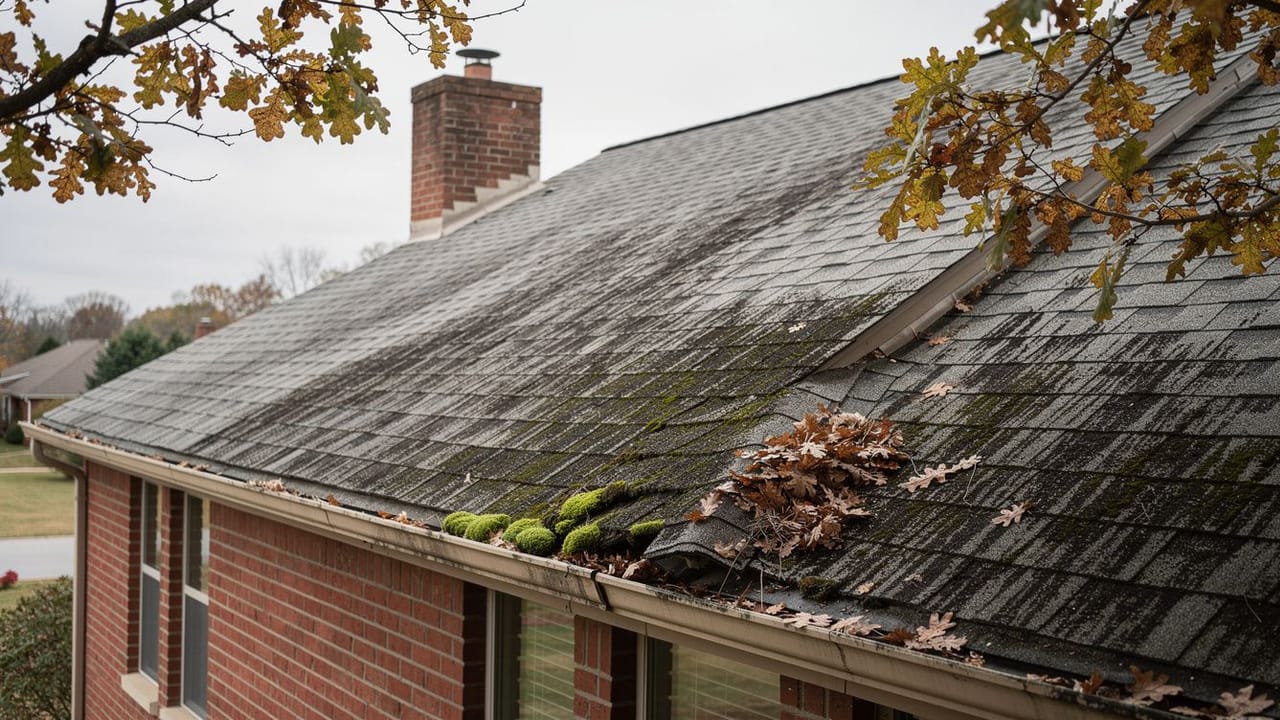
Drive through any neighborhood in Middle Tennessee and you will see it: roofs with dark vertical stripes, heaviest on the side that gets the least sun. Homeowners often read it as mildew, soot or a roof going bad. Shingle makers have a name for it. Atlas Roofing’s limited shingle warranty describes the marks as black streaks caused by blue-green algae and deals with them in a clause of their own, apart from its coverage for manufacturing defects that cause leaks. That is why we treat the streaks as a question of looks first. Moss is a different matter, and so is the cleaning, which is where we see the most avoidable harm done to a roof.
Algae, moss and lichen are not the same problem
The streaks are that algae, and CertainTeed’s residential roofing page describes it as airborne. On the roofs we see, the stripes follow the slope down from the ridge, so the pattern looks like something dripped. The EPA’s guide to cool roofs explains that the more sunlight a roof reflects, the less heat it takes in, and it lists keeping the surface clean as part of holding that reflectance, so a roof darkened by streaks is not helping on that front either. And a buyer will see it from the curb.
Moss grows in thick green cushions, and on the roofs we inspect it is usually along the bottom edges of the shingles and in valleys shaded by trees. That is the growth we take more seriously, and we want to see the shingle under it before saying anything about cleaning. Lichen, the flat gray-green crusts that look painted on, clings tight to the granules. The warranties draw the same line we do: Atlas’s algae coverage applies only to black streaks from blue-green algae, and it excludes discoloration from green algae, lichen, moss, mold and mildew.
Why are north slopes and shaded roofs worse?
On the roofs we look at, all three are heaviest wherever the surface stays damp longest after rain or morning dew. A north-facing slope gets the least sun and is usually the last to dry. A roof under an oak or a big maple spends the fall covered in wet leaves and the summer in shade, and the leaves pile up in valleys and on the uphill side of chimneys. Those are also the places a roof depends on flashing rather than shingles, and they come up again in our post on where roofs actually leak.
This is the time of year to look, as the leaves start coming down and the roof shows what has been growing under them. Our advice is to trim branches back so the roof gets more sun and air and catches fewer leaves, and to keep the valleys and the uphill side of each chimney clear, since those damp pockets are where we most often find moss getting its start.
Cleaning it without ruining the shingles
We never put a pressure washer on an asphalt roof. The top of a shingle is a coat of mineral granules pressed into asphalt, and Atlas’s warranty even notes that new shingles wash off some excess granules in their first months; we are not going to aim a jet of water at a surface like that. Read your warranty before anyone else tries it: Atlas’s standard limited warranty excludes damage from any cause other than a manufacturing defect, and damage from foot traffic on the roof, so harm done during a cleaning would fall on the owner.
The gentler route is a cleaner labeled for use on roofs, applied at low pressure the way its label says, left to work and then rinsed lightly or left for the rain to finish. Loosen moss with the cleaner and brush it off downhill, with the laps, never scraped upward against them. Read what the label says about plants, and wet down or cover the beds under the eaves. Then there is the climb. OSHA’s fall prevention campaign calls falls the leading cause of death in construction and expects employers to provide fall protection for workers six feet or more above a lower level. We would not ask a homeowner to stand on a pitched roof wet with cleaner, and if you would rather not either, ask us for an estimate.
- Low pressure only, never a pressure washer
- Brush moss downhill, with the shingle laps
- Wet down and cover plantings under the eaves
- Read the cleaner’s label and your shingle warranty first
How do you keep algae from coming back on a roof?
The lasting fix is in the shingle itself. Atlas’s warranty refers to the copper released from the granules of its algae-resistant shingles, and CertainTeed sells its StreakFighter shingles against black streaks from airborne algae. On a replacement here, that is worth asking for by name, and our roof replacement page sets out the shingle, metal and synthetic options.
Read that part of the warranty on its own, because algae coverage is written separately from the shingle’s main term. Atlas gives its ARS algae-resistant shingles ten years against black streaks, prorated after the first year and limited to cleaning or replacing the streaked shingles, while CertainTeed puts its StreakFighter coverage at 25 to 30 years, so the number depends on the maker and the line. Our post on what a roof warranty does not cover goes through the rest of the fine print. When our crews look at an older roof with heavy moss, we check the shingle edges under the growth before recommending anything: if the tabs have curled or the mat is soft, cleaning will not bring them back, and the conversation moves on to repair or replacement.
Sources
- Atlas Roofing Corporation, Limited Shingle Warranty (residential, products installed on or after May 1, 2026) — Black streaks caused by blue-green algae; separate algae-resistance clause (ARS: ten years, prorated after year one, clean or replace streaked shingles); excludes green algae, lichen, moss, mold and mildew discoloration; copper released from algae-resistant granules; excess granule wash-off on new shingles; excludes damage from any cause other than a manufacturing defect and foot traffic
- CertainTeed, Residential Roofing — StreakFighter protects against black streaks caused by airborne algae, with warranty coverage ranging from 25 to 30 years
- U.S. EPA, Using Cool Roofs to Reduce Heat Islands — Higher solar reflectance means less heat absorbed; periodic cleaning keeps a roof’s reflectance up
- OSHA, Fall Prevention Campaign — Falls are the leading cause of death in construction; fall protection for work six feet or more above a lower level, including roof work
FAQ
Black Streaks and Moss on a Nashville Roof — questions
Do black streaks on my roof mean it needs replacing?
Not by themselves. Shingle warranties treat the streaks as algae discoloration, with cleaning among the remedies, rather than as a shingle that has failed. What decides replacement is the condition underneath, so on an inspection we look for curled or cracked tabs, bare spots where the granules are gone, and any sign of a leak.
Can I pressure wash moss off my roof?
We would not, and we never use one on asphalt shingles. The surface is a coat of mineral granules, and a shingle warranty covers manufacturing defects, not damage done while cleaning. Use a low-pressure cleaner labeled for roofs and brush moss off gently in the direction the shingles overlap.
Does homeowners insurance pay to clean algae or moss off a roof?
Do not count on it. Budget for cleaning as upkeep, and before the work is done read your own policy and ask your agent how it treats anything connected to moss or algae, including a leak that turns up under a mossy patch, because that comes down to the wording of the policy.
How do you get black streaks off a roof?
Use a roof-labeled cleaner at low pressure, as its label directs, let it work, then rinse lightly or let the rain finish it. Never put a pressure washer on the granule surface. Wet down or cover the plantings under the eaves, and read your shingle warranty before anyone starts.