
· by Michael Blair, Nashville's Roofers
A leak in the open field of a roof is rare in our experience. Most of the leaks we trace get in where the roof stops being a plane, at a chimney, a valley, a vent or a wall junction, because that is where it depends on flashing rather than on shingles. It is worth finding the real entry point quickly: leaking roofs head the EPA’s list of common moisture problems behind mold growth in buildings.
The usual suspects, in order
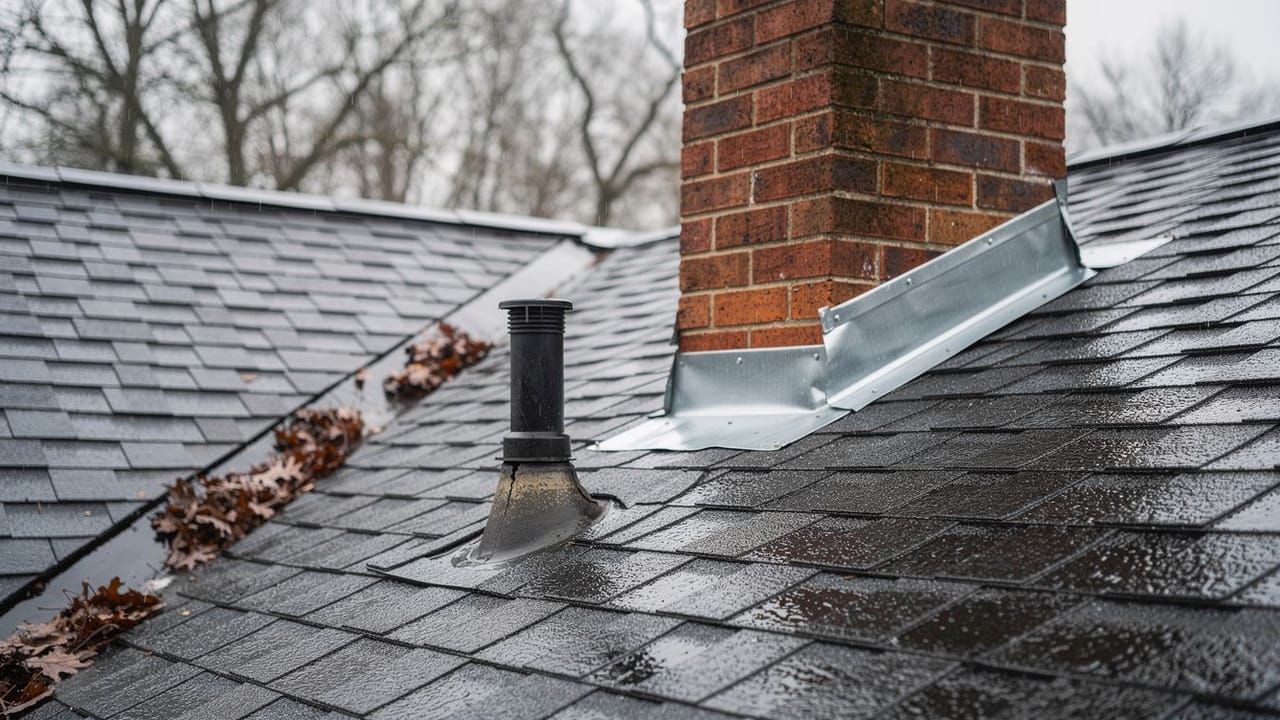
The order below is our own, built from the leaks we have traced, and it is the order we check in. Chimney flashing comes first, particularly step flashing that was surface-sealed instead of let into the mortar. On the roofs we work on, a sealed joint like that opens up long before properly counter-flashed metal does.
Then pipe boots, where we often find the rubber collar around a plumbing vent cracked. Then valleys, then wall-to-roof junctions, then skylights. Our roof repair service starts at the top of this list and works down it.
- Chimney step and counter flashing
- Plumbing vent pipe boots
- Valleys, especially where debris collects
- Roof-to-wall junctions and dormer sides
- Skylight curbs and head flashing
Why isn’t the ceiling stain right under the leak?
On the jobs we trace, water that gets in at a penetration often runs down the decking or along a rafter before it finds something to drip from. The stain on the ceiling can sit several feet from where the water entered, sometimes on the far side of a joist.
The EPA’s mold course counts roof materials above ceiling tiles among the places moisture hides, which is the same lesson from inside the room: what shows is rarely all of it. So we start at the nearest penetration uphill of the stain, and we leave the ceiling alone until the roof is dry.
The leaks that are not the roof
Condensation can pass for a roof leak. When warm, humid air meets a cold surface, condensation may form, as the EPA explains. If the drips turn up on dry days, we look at ventilation before shingles, since blocked soffit vents can cause it; our post on attic ventilation in Nashville covers what we check up there.
Gutter overflow is the other one. The EPA lists gutters and downspouts that direct water into or under a building as a common moisture problem, and a clogged gutter can spill water behind itself into the fascia and down the wall, where it reads as a roof failure. When the wet patch sits right under a full gutter, we clear the gutter before anyone prices a roof, and that work is on our gutters and flashing page.
What does a proper roof leak repair look like?
Flashing replaced rather than sealed. Roofing cement smeared over a failing joint is a short-term patch that can hide a leak that is still going on, and the EPA warns that if a roof is allowed to leak long enough, molds can weaken floors and walls by feeding on the wet wood.
Pipe boots replaced, with the new boot’s upper flange slid under the shingle course above it instead of caulked over the top. We work to the residential code the Tennessee State Fire Marshal’s Office has adopted, the 2018 International Residential Code with state amendments. A quote that consists mainly of sealant is buying time, and if you want the joint opened up and looked at properly, ask us for a free estimate.
Sources
- US EPA, Mold Course Chapter 2: Why and Where Mold Grows — Leaking roofs and gutters that direct water into or under a building as common moisture problems; roof materials above ceiling tiles as a place of hidden moisture; condensation where warm, humid air meets a cold surface; a long-running roof leak lets mold weaken wet wood
- Tennessee Department of Commerce and Insurance, State Fire Marshal’s Office, Currently Adopted Codes — International Residential Code, 2018 edition, with amendments, adopted by the State Fire Marshal’s Office (effective 7/16/2020)
FAQ
Roofs Almost Never Leak in the Middle — questions
Can a roof leak without any visible damage from the ground?
Yes. Failed pipe-boot collars, lifted step flashing and split valley metal are often hard to see from the ground, even with binoculars from the driveway. A roof that looks fine from the street can still leak in heavy rain, so a clean view from the yard does not rule anything out.
Why does my roof only leak in wind-driven rain?
Wind can push rain sideways, under shingle edges and into wall junctions that handle straight-down rain without trouble. When a leak shows up only in storms from one direction, we start on that side of the house and check the wall-to-roof junctions, the sidewall flashing and the drip edge there first.
Is a leak always a reason to replace the roof?
No, and a roofer who calls for a new roof over a single leak deserves skepticism. A cracked pipe boot on an otherwise sound roof needs a new boot. What leads us to recommend replacement is shingles failing across the whole roof, several leaks at different penetrations, or decking that has already been damaged over an area.
How do you find where a roof is leaking?
Start at the nearest roof penetration uphill of the ceiling stain, not directly above it, because water often runs along the decking or a rafter first. We check in order: chimney flashing, pipe boots, valleys, wall junctions, then skylights. Drips that show up on dry days send us to the attic ventilation before the shingles.