
· by Michael Blair, Nashville's Roofers
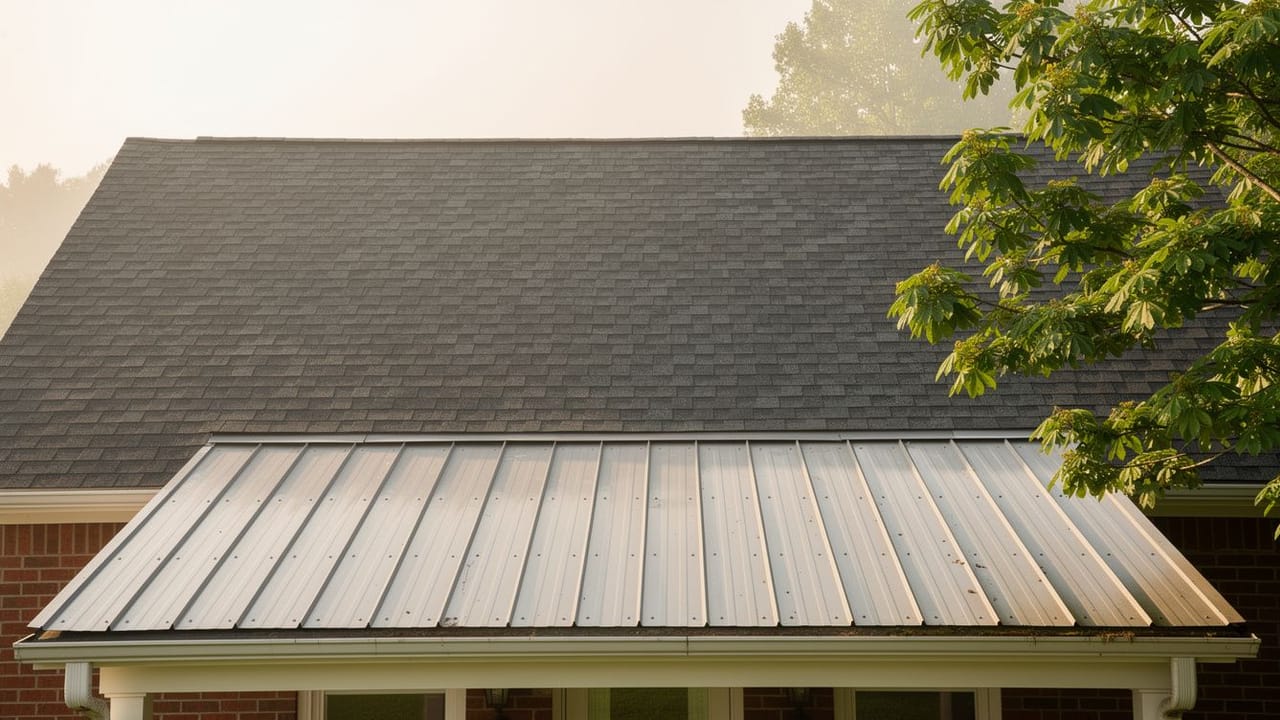
Standing-seam metal usually costs a good deal more than an architectural asphalt roof, and the case for it rests on lasting longer. How much more depends on the house, so when we price a roof replacement we’re glad to quote both on the same roof. What decides it in Middle Tennessee is hail, attic heat, and how long you plan to stay.
How each handles our weather
Hail is where the two part ways. Impact-rated asphalt shingles exist for exactly this, but IBHS’s hail ratings for impact-resistant shingles warn that they don’t all perform the same, and the ratings score each product on dents, tears and granule loss. If you stay with asphalt, pick the shingle by its rating instead of the words on the wrapper.
On metal, what we find after a storm is dents. Whether a dented panel still keeps water out depends on the panel and its seams, and we check that on the roof instead of assuming it either way. The independent testing we know of, IBHS’s study of hail on low-slope metal roofing, is about nearly flat roofs, not the pitched roof on a house. Our post on telling hail damage from ordinary wear walks through what an inspection looks for.
Heat is the other factor, and the finish matters more than the material. The EPA’s guide to cool roofs names high solar reflectance as the most important trait of a cool roof and says that in air-conditioned homes it can reduce peak cooling demand by 11 to 27 percent. Its list of steep-slope cool products includes metal shingles or tiles coated with reflective paint and asphalt shingles with light or cool-colored granules, so the color you choose counts for more than whether it is metal. Whatever heat the roof does take in still has to leave the attic, which is the subject of our post on attic ventilation.
Rain noise and lightning on a metal roof
The drumming people remember is usually a barn, with metal screwed over open purlins and nothing underneath. When we put metal on a house it goes over solid decking and underlayment, which is a different assembly. How quiet is quiet enough is yours to judge, so stand under a neighbor’s metal roof during a rain before you rule it out.
Metal does not attract lightning. The National Weather Service’s page on lightning myths says the presence of metal makes no difference to where lightning strikes; height, a pointed shape and isolation decide it. The same page adds that metal does conduct lightning, so the fair claim for a metal roof is that it is no more likely to be hit, and we don’t go further than that.
Why does a metal roof cost more on some houses?
On standing seam, every hip, valley, chimney and vent is a detail we form and fit by hand, so we price metal by the shape of the roof as much as by its size. That is why we won’t give you a rule-of-thumb multiple over asphalt.
A simple gable roof has few of those details. A cut-up roof with six dormers has dozens, and that is where the two quotes tend to land furthest apart.
- Simple gable and hip roofs: the fewest hand-formed details in metal
- Cut-up roofs with dormers and valleys: the most details, and the widest gap
- Exposed-fastener panels: a different system from standing seam, so compare like with like
- Impact-rated asphalt: compare the specific shingle’s IBHS rating, since results vary by product
How does the time you plan to stay change the choice?
If you expect to sell in a few years, asphalt is usually the sensible choice. Metal’s case rests on a long life, and you have to still own the house to collect on it; we can’t promise a buyer will pay you back the difference.
If you plan to stay for decades, metal is worth pricing against a shingle roof and the one that might follow it. Get the warranty terms for both in writing, and if you want the two priced on your own house, ask us for a free estimate.
Sources
- IBHS, Hail Impact-Resistant Shingle Ratings — Not all impact-resistant asphalt shingles perform the same; ratings detail dents, tears and granule loss by product
- IBHS, Hail Impact Performance of Low-Slope Metal Roofing — IBHS hail testing of metal roofing covers low-slope roofs
- US EPA, Using Cool Roofs to Reduce Heat Islands — Solar reflectance is the key trait of a cool roof; 11–27% lower peak cooling demand in air-conditioned homes; steep-slope cool products include reflective-painted metal and light-granule asphalt shingles
- NOAA National Weather Service, Lightning Myths — Metal makes no difference to where lightning strikes; height, shape and isolation do; metal conducts lightning
- Metro Nashville Codes, Adopted Codes List — Lists the 2024 International Residential Code among the codes Metro has adopted, with local amendments; named in the FAQ on metal over shingles
FAQ
Metal or Asphalt Shingle in Tennessee — questions
Does a metal roof lower insurance in Tennessee?
Ask your carrier before you count on it. Whether a metal roof or an impact rating changes your premium is up to each insurer, so get the figure in writing for the exact product you are considering, and make the choice on its other merits until you have it.
How long does an asphalt roof last in Middle Tennessee?
We don’t put one number on it, because the shingle line, its color and the attic’s ventilation change the answer from house to house. The manufacturer’s warranty tells you what the shingle is rated for; on every replacement we check the attic’s intake and exhaust, since that is the part we can improve.
Can metal go over existing shingles?
Whether it is allowed comes down to the code and the metal maker’s installation instructions. Metro Nashville Codes lists the 2024 International Residential Code, with local amendments, among the codes it has adopted, so the re-cover rules are worth confirming with Metro Codes or your own county’s codes office. Even where it is allowed, we would rather tear off: going over the old layer buries whatever condition the deck is in and gives up the chance to inspect and repair the sheathing.
Can hail damage metal roofs?
It can dent them, and dents are what we find on metal after a storm. Whether a dented panel still keeps water out depends on the panel and its seams, so we check it on the roof rather than assume. The independent hail testing we know of, from IBHS, covers low-slope metal, not a pitched house roof.